Last Updated: October 27, 2026 by Pratham Agarwal, Rasp International
The short answer
FLOW (Facilitating Logistics, Overseas Warehousing and Fulfilment) is Export Promotion Mission (EPM) support that pays 30 percent of the lease and running cost of an overseas warehouse, fulfilment arrangement, display facility or E-Commerce Export Hub for up to three years, under Directorate General of Foreign Trade (DGFT) Trade Notice 28/2025-26 dated 20 February 2026. Councils, boards, logistics providers, associations, clusters, government bodies and recommended entities propose projects; exporters use the facility.
The rule that decides everything: FLOW pays the agency with the approved project, not the exporter. Only an Indian-incorporated entity listed in Annexure II paragraph 2(b) of Trade Notice 28/2025-26 can propose a project, and the project must give Indian Micro, Small and Medium Enterprises (MSMEs) at least 20 percent of annual merchandise volumes (paragraph 2(d)).
Verified as on 27 October 2026 against DGFT Trade Notice 28/2025-26 dated 20 February 2026, the DGFT trade notice list to 26 October 2026, the DGFT and Trade Connect FLOW pages, Press Information Bureau (PIB) releases of 12 November 2025 and 20 February 2026 and the PIB backgrounder of 24 February 2026. Written by Pratham Agarwal, Founder, Rasp International.
30%
government share of the proposal cost, Annexure II paragraph 4, Trade Notice 28/2025-26
Rs 10 crore
yearly ceiling for an overseas warehouse or an E-Commerce Export Hub, paragraphs 4(a) and 4(d)
20%
minimum share of annual merchandise volumes for Indian MSMEs, paragraph 2(d)
3 years
maximum support period per project, paragraph 3(b)
| Scheme | Facilitating Logistics, Overseas Warehousing and Fulfilment (FLOW) |
|---|
| Part of | Niryat Disha arm of the Export Promotion Mission (PIB, 12 November 2025) |
|---|
| Run by | EPM Section of DGFT, advised by the Sub-Committee on Warehousing and Logistics (Annexure III) |
|---|
| Legal basis | DGFT Trade Notice 28/2025-26 dated 20 February 2026, a pilot (paragraph 5) |
|---|
| Who it is for | Applicants: Export Promotion Councils (EPCs), Commodity Boards, logistics providers, associations, clusters, government bodies and recommended entities. Users: exporters |
|---|
| What you get | 30 percent of lease, common facility and operating costs, no capital expenditure (paragraphs 3(a) and 4) |
|---|
| Cap | Rs 10 crore a year (warehouse or hub), Rs 5 crore a year (display facility) and Rs 5 lakh a month (fulfilment) |
|---|
| Validity or window | From 20 February 2026, as a pilot; the notice sets no closing date; at most 3 years per project |
|---|
| Where you apply | The online form in paragraph 6, opened on 27 October 2026 by Apply on the Trade Connect ePlatform (trade.gov.in) FLOW page |
|---|
Why this page exists
The PIB release of 20 February 2026 says FLOW “supports exporters in accessing overseas warehousing and fulfilment infrastructure”. Many exporters read that as a subsidy they can claim. An exporter cannot claim it in its own right: Annexure II paragraph 2(b) of Trade Notice 28/2025-26 lists councils, boards, service providers, associations, clusters, government bodies and recommended entities as applicants, and paragraph 6 pays the approved project.
This page serves exporters and proposing agencies. Rasp International is an ISO 9001:2015 certified export and import (EXIM) and DGFT advisory firm, founded in 2019, that has served 500 plus exporters.
What FLOW is
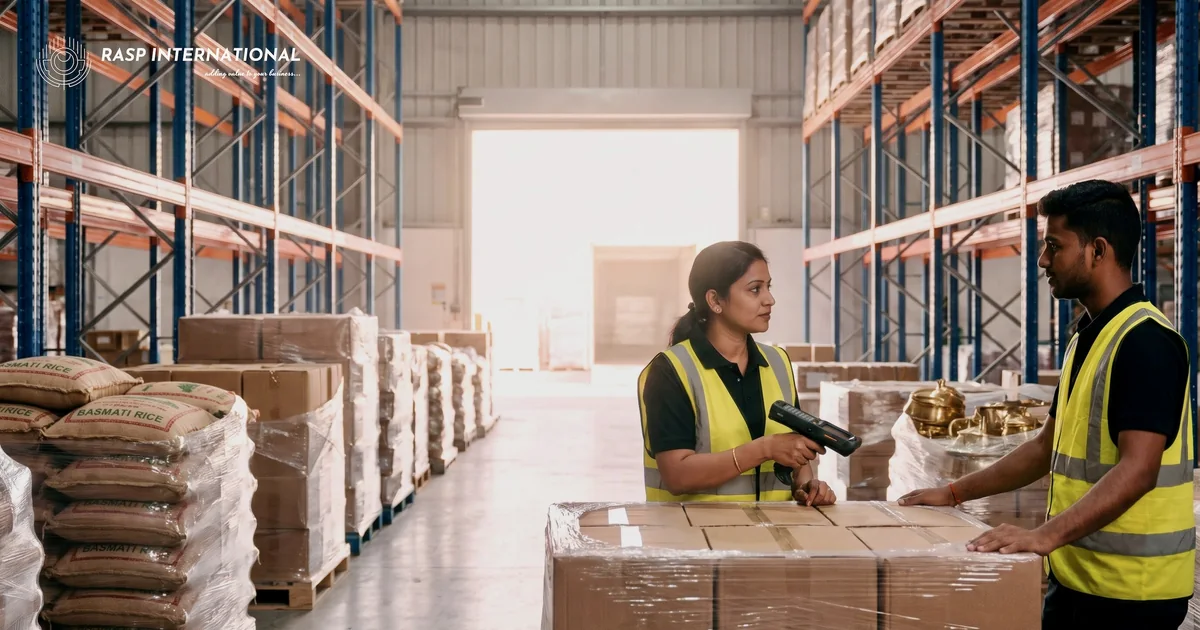
 FLOW pays part of the lease and running cost of an approved overseas warehouse; the agency that runs it is paid, not the exporter.
FLOW is a project support intervention that pays part of the lease and running cost of overseas warehouses, fulfilment arrangements, display facilities and E-Commerce Export Hubs used by Indian exporters, run by the EPM Section of DGFT under the Niryat Disha arm of the Export Promotion Mission. The PIB release of 12 November 2025 gives the Mission Rs 25,060 crore for financial years 2025-26 to 2030-31 and lists “export warehousing and logistics” under Niryat Disha. Our Export Promotion Mission guide maps every intervention.
An E-Commerce Export Hub (ECEH) is a designated area in India that acts as a centre for cross-border e-commerce infrastructure, under Foreign Trade Policy (FTP) 2023 paragraph 9.08. FLOW’s hub support covers warehousing and fulfilment through notified ECEHs in India, linked to overseas networks (Annexure II paragraph 2(c)(iv)). New sellers can start with our cross-border e-commerce export setup guide.
The Sub-Committee on Warehousing and Logistics, chaired by the Additional DGFT in charge of the EPM Division, advises and recommends (Annexure III paragraphs 1(a) and 1(c)).
What you get under FLOW
A display or market access facility abroad is one of the four project types FLOW can fund.| Project type | What the notice means by it | Government share and ceiling |
|---|
| Overseas Warehousing Facility | A facility outside India for storage, returns processing or distribution, owned, leased or third party (Annexure II paragraph 1(a)) | 30 percent, up to Rs 10 crore a year (paragraph 4(a)) |
| Overseas Fulfilment Arrangement | A contract for local storage, last-mile delivery, customer service or returns abroad, including pay-per-use and drop-shipping (paragraph 1(b); Annexure I paragraph 2(c)) | 30 percent, up to Rs 5 lakh a month (paragraph 4(b)) |
| Display or Market Access Facility | A physical overseas space for display, sampling and buyer meetings, with no retail sales to final consumers (paragraph 1(c)) | 30 percent, up to Rs 5 crore a year (paragraph 4(c)) |
| E-Commerce Export Hub | Export warehousing and fulfilment through a notified ECEH in India under FTP Chapter 9 (paragraph 2(c)(iv)) | 30 percent, up to Rs 10 crore a year (paragraph 4(d)) |
- Covered: lease or rental, common facility and operating costs of the project (Annexure II paragraph 3(a)).
- Not covered: capital expenditure (money spent to buy or build an asset).
Illustrative example. A shared warehouse abroad costs Rs 12 crore a year to lease and run. Thirty percent is Rs 3.6 crore, under the ceiling, so the agency may be able to receive that, subject to approval and the available budget. A Rs 30 lakh a month fulfilment contract gives Rs 9 lakh at 30 percent, capped at Rs 5 lakh by paragraph 4(b).
Who can apply and who cannot
Who can propose a project
Only entities incorporated in India are eligible (Annexure II paragraph 2(a)), from the kinds in paragraph 2(b).
Councils and boards
EPCs and Commodity Boards recognised under Appendix 2T of the FTP.
Logistics providers
Logistics, warehousing or fulfilment providers with demonstrable international operations.
Associations and clusters
Industry associations or recognised exporter clusters.
Government bodies
Central and State Government organisations, or an entity either government recommends.
Committee recommended
An entity recommended by a State Export Promotion Committee (SEPC) or District Export Promotion Committee (DEPC).
Who uses a FLOW facility
Exporters are the users. Paragraph 2(d) says at least 20 percent of annual merchandise volumes must go to Indian MSMEs.
Who cannot
- An exporter applying in its own right, outside paragraph 2(b).
- An entity incorporated abroad, such as a foreign subsidiary holding the lease (paragraph 2(a)).
- An entity under investigation, debarred or blacklisted under the Foreign Trade (Development and Regulation) Act 1992 or allied laws, or with penalties outstanding (Annexure IV declaration 1).
Documents that get it through
| Document | What the authority checks | The mismatch that brings a query or rejection |
|---|
| Application form and declaration | Project type in item 4 and a signatory authorised under FTP paragraph 11.06 (declaration 6) | A signatory without authority, or a project type that differs from the plan |
| Project plan (location, size, cost, model) and lease | That the location and the per square foot charge in item 8 match the signed lease | Plan and lease name different sites or rates |
| Cost break-up (leasing, operational, other) | Only lease, common facility and operating costs (paragraph 3(a)) | Equipment, fit-out or vehicle purchases, excluded as capital expenditure |
| Entity list by Importer Exporter Code (IEC), if available, and warehousing strategy | That the 20 percent MSME floor in paragraph 2(d) can be met in the target markets | No named MSME users or product groups |
| Financing pattern and other funding sources | The 30 percent share and no funding of the same expenditure elsewhere (paragraph 7(b)) | Rent already met by another central or state scheme |
| Host country licence status and prior experience | Approvals the host country needs (paragraph 8(c)) and international operations (paragraph 2(b)(ii)) | A facility not cleared to operate, or a provider with domestic work only |
| Utilisation certificate for each later instalment | Sanction order, amounts released and utilised, unspent balance, countersigned by a chartered accountant, auditor or head of entity | Figures that do not match the books (certificate item 1) |
How to apply, stage by stage
For an agency proposing a project
1
Before you apply: line up the facility
Get the lease, partner agreements, host country approval status and a user exporter list. Paragraph 8(b) asks for due diligence on overseas partners, including consultation with the Indian Mission abroad.
2
Before you apply: build the numbers
Split cost into leasing per square foot, operating and other items, and show own funds against the amount sought (items 8, 9 and 18).
3
Filing: submit the proposal online
Paragraph 6 names an online form “until further notice”. On 27 October 2026 the DGFT FLOW page sends Apply to the Trade Connect FLOW page, whose Apply button opens that form; the PIB backgrounder of 24 February 2026 says trade.gov.in. Check with the EPM Section of DGFT.
4
After filing: appraisal and approval
The Indian Mission may comment (Annexure III paragraph 3(a)). The PIB backgrounder of 24 February 2026 says the EPM Division evaluates, the Sub-Committee recommends and the Steering Committee approves.
5
After approval: instalments against proof
The first instalment follows approval. Each later one needs a utilisation certificate and certified physical and financial progress (Annexure II paragraphs 6(b) to 6(d)).
For an exporter who wants space abroad
2
Check the sanction
Ask the operator for its sanction order number and date. The utilisation certificate format in the notice is built around that order.
3
Get the terms in writing
The notice sets no user price or term. Put rate, minimum period, returns and exit terms in your contract.
The lapse rule. The notice sets no closing date. After approval, late reports or utilisation certificates may bring ineligibility and recovery (Annexure II paragraph 6(g)), and an advance is refundable with applicable interest if objectives are missed (paragraph 6(f)). Whether pre-approval costs count is not stated. Check with the EPM Section of DGFT.
Planning a FLOW proposal for your council or warehouse
Send us the project type, country and user exporters. We check the plan against Trade Notice 28/2025-26 and can prepare and file the proposal in your entity’s own name.
Where FLOW proposals go wrong
Patterns from Trade Notice 28/2025-26, not named cases.
| Failure | What you see | What actually broke |
|---|
| An exporter proposes its own warehouse | Proposal not taken forward | Not one of the kinds in paragraph 2(b), with no government, SEPC or DEPC recommendation |
| The overseas subsidiary applies | Eligibility questioned | Paragraph 2(a) admits only entities incorporated in India |
| Capital items in the cost | Cost lines cut | Paragraph 3(a) excludes capital expenditure |
| MSMEs get under 20 percent of volumes | Later instalments at risk, advance refundable | Paragraph 2(d) sets the floor; paragraph 6(f) makes advances refundable with interest |
| Same rent claimed under another scheme | Recovery and possible penal action | Paragraph 7(b) and declarations 4 and 5 in Annexure IV |
How FLOW fits with other schemes
| Scheme | What it pays for | Who applies | How it differs |
|---|
| Credit Assistance for E-Commerce Exporters, Trade Notice 31/2025-26 | Bank working capital up to Rs 50 lakh, or Rs 5 crore for stock abroad, plus 2.75 percent interest subvention up to Rs 15 lakh a year (Annexure II paragraph 5) | The MSME exporter, through its bank | A loan for the exporter’s stock; FLOW pays the facility’s lease and running cost |
| Market Access Support (MAS), Trade Notice 19/2025-26 | Fairs, buyer seller meets and delegations, up to Rs 5 crore per event (paragraphs 6.2(d) and 6.4(d)) | Organising agencies, on Trade Connect | An event; FLOW’s display facility is a standing space abroad |
| Logistics Interventions for Freight and Transport (LIFT), Trade Notice 29/2025-26 | Up to 30 percent of inland freight from notified districts, up to Rs 20 lakh per IEC a financial year (Annexure II paragraphs 2(b) and 2(c)) | The MSME exporter | Freight inside India; FLOW covers storage and fulfilment |
The no double benefit rule. Annexure II paragraph 7(b) of Trade Notice 28/2025-26 bars FLOW for the same project or expenditure under any other Government of India scheme, and declaration 5 in Annexure IV adds State Government schemes. Check with the EPM Section of DGFT before combining two schemes on one facility.
What FLOW will not do
1
It will not pay an exporter directly
Annexure II paragraph 6(a) pays the eligible entity for the approved project. The notice sets no price for exporters using the space.
2
It will not pay for buying or building
Paragraph 3(a) excludes capital expenditure, so FLOW shares only lease and running cost.
3
It will not run past three years
Paragraph 3(b) caps support at 3 years, and paragraph 8(d) wants a plan for the years after.
How Rasp International handles FLOW
When an eligible agency engages us, we prepare and file the FLOW proposal end to end, always in the agency’s own name; agencies may also file themselves with our guidance. We sign a non-disclosure agreement (NDA) and a service level agreement (SLA) with every client. The client and we both hold the portal logins, kept safe and confidential, and documents sit in encrypted storage. We give an authority letter only on request. We hold no customs broker (CHA) licence; licensed CHA partners across India handle customs clearance. Read how we work.
Your association or cluster wants a FLOW facility abroad
When the proposing entity engages us, we prepare and file the FLOW proposal end to end in its own name, or guide it if it files itself.
What Is Not Yet Notified, Checked on 27 October 2026
- The final application route. The notice names a form “until further notice”, while the PIB backgrounder of 24 February 2026 says trade.gov.in, so the two disagree. Check with the EPM Section of DGFT.
- Any approved FLOW project or location. None appears on the DGFT trade notice list or FLOW page. Check with the EPM Section of DGFT or your Export Promotion Council.
- User price, space allocation and contract terms beyond the 20 percent MSME floor. Check with the agency that runs the facility.
- Whether the Rs 5 lakh fulfilment ceiling is per project or per arrangement, whether “per year” means the financial or the project year, the “applicable interest” rate on refunds and any decision timeline or appeal route. Check with the EPM Section of DGFT.
- Whether an exporter company recommended by a DEPC may propose its own facility. Check with the EPM Section of DGFT.
Frequently asked questions
What is the FLOW scheme under the Export Promotion Mission?
FLOW, or Facilitating Logistics, Overseas Warehousing and Fulfilment, is a Niryat Disha intervention launched by DGFT Trade Notice 28/2025-26. It pays approved agencies 30 percent of the lease and running cost of overseas warehouses, fulfilment, display facilities and export hubs, for up to three years.
Can an individual exporter apply for FLOW support?
Not in its own right. Annexure II paragraph 2(b) of Trade Notice 28/2025-26 lists councils, commodity boards, logistics providers, associations, clusters, government bodies and recommended entities as applicants. An exporter benefits by using space in a project that one of them runs.
How can a small exporter use a FLOW warehouse abroad?
Ask your Export Promotion Council, industry association and District Export Promotion Committee whether they run or back a FLOW project. Ask the operator for its sanction order, and get the price and terms in writing, because Trade Notice 28/2025-26 does not set them.
How much does the government pay under FLOW?
Paragraph 4 of Trade Notice 28/2025-26 pays 30 percent of the proposal cost, capped at Rs 10 crore a year for a warehouse, Rs 5 lakh a month for fulfilment, Rs 5 crore a year for a display facility and Rs 10 crore a year for an export hub.
Does FLOW pay for buying or building a warehouse abroad?
No. Annexure II paragraph 3(a) of Trade Notice 28/2025-26 limits eligible spending to lease or rental charges, common facility costs and operating expenses of the approved project, and excludes capital expenditure. FLOW does not pay for buying land, buildings or equipment.
What is the 20 percent MSME condition in FLOW?
Annexure II paragraph 2(d) of Trade Notice 28/2025-26 says an approved project must provide at least 20 percent of its annual merchandise volumes to Indian MSMEs. It is a minimum share, not a limit on who else may use the facility, and missing it risks recovery of advances.
How long does FLOW support last for a project?
Annexure II paragraph 3(b) of Trade Notice 28/2025-26 caps support at three years per project. Paragraph 8(d) asks each proposal to show how the facility will run after government support ends, so the plan for year four belongs in the proposal.
Where is a FLOW proposal submitted?
Paragraph 6 of Trade Notice 28/2025-26 names an online form until further notice, and on 27 October 2026 the Apply buttons on the DGFT and Trade Connect FLOW pages lead to it. The PIB backgrounder of 24 February 2026 says trade.gov.in. Confirm the route with the EPM Section of DGFT.
Can FLOW be combined with the e-commerce exporter credit?
They pay for different things. The credit under Trade Notice 31/2025-26 is a bank loan for an exporter’s stock, while FLOW pays an agency part of a facility’s running cost. FLOW’s undertaking bars the same expenditure under another government scheme, so never claim one cost twice.
What happens if a FLOW project misses its targets?
Under Annexure II paragraph 6(f) of Trade Notice 28/2025-26, an advance is refundable with applicable interest if approved objectives are not met. Force majeure delays go for recommendation under paragraph 8(f), and paragraph 8(g) allows withdrawal, recovery or debarment for ineffective operations.
Is there a list of approved FLOW warehouses?
Not as on 27 October 2026. The DGFT trade notice list, checked to Trade Notice 32/2026-27, has no FLOW notice after Trade Notice 28/2025-26, and the DGFT FLOW page lists no projects. Ask the EPM Section of DGFT or your council.
Can a FLOW display facility sell products to customers abroad?
Not to final consumers. Annexure II paragraph 1(c) of Trade Notice 28/2025-26 defines a display or market access facility as an overseas space for display, sampling, buyer meetings or showcasing Indian products, without retail sales. Retail selling takes a project outside that definition.
Sources
- Tier 1. DGFT Trade Notice No. 28/2025-26 dated 20 February 2026, launch of FLOW, Annexures I to IV: content.dgft.gov.in.
- Tier 1. DGFT FLOW page: dgft.gov.in; Trade Connect FLOW page: trade.gov.in.
- Tier 1. DGFT trade notice list to Trade Notice No. 32/2026-27 dated 26 October 2026, with Trade Notices 19/2025-26, 29/2025-26 and 31/2025-26: dgft.gov.in.
- Tier 1. PIB: Cabinet approval, 12 November 2025, Release ID 2189383; launch of seven interventions, 20 February 2026, Release ID 2230664; EPM backgrounder, 24 February 2026, pib.gov.in.
- Tier 1. Foreign Trade Policy 2023, Chapter 9 and Appendix 2T, DGFT: dgft.gov.in.
This is general guidance. Rules change. Check the current notification or trade notice, or speak to us, before you act.
Related: EPM trade notice explainer | E-commerce export setup for Indian sellers | Market Access Support for fairs and meets